Peeling Is Usually a Process Problem, Not Just a Material Problem
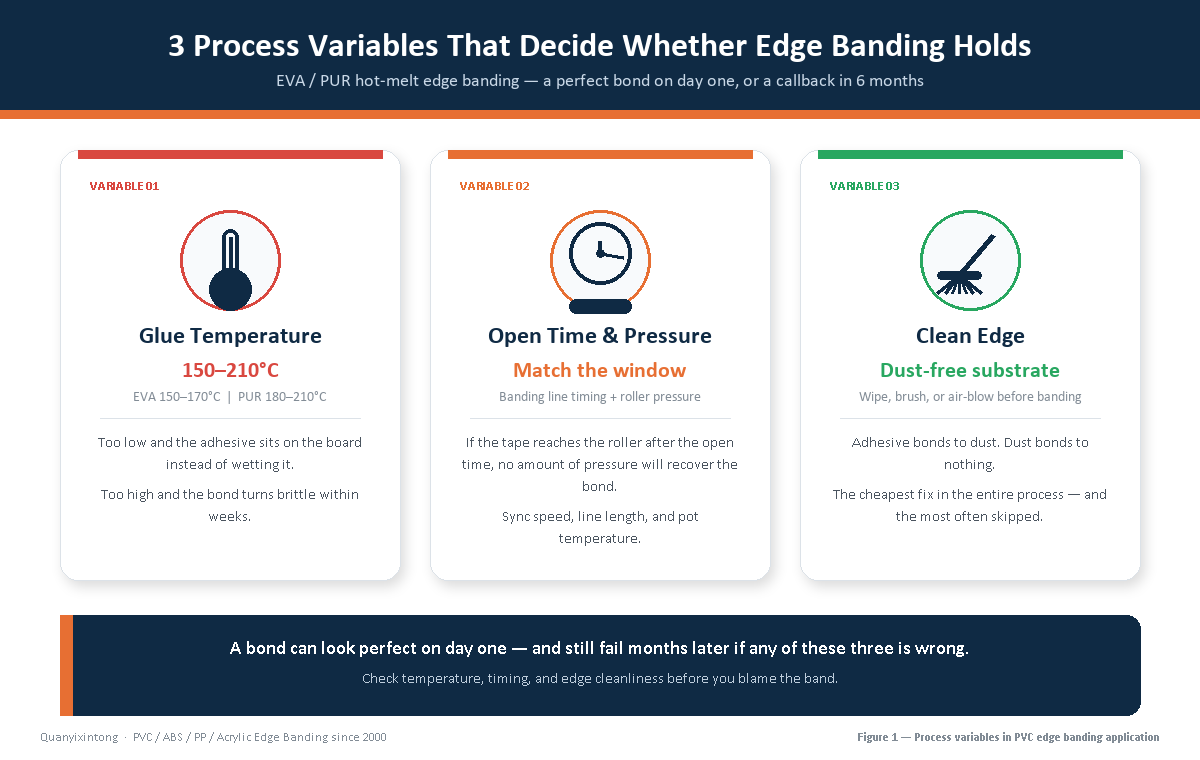
When an edge lifts, the band usually gets blamed. But in most cases the band itself is intact—what failed is a layer of adhesive about a fifth of a millimeter thick. That thin layer depends on three things:
- Glue temperature. Too low, and the adhesive sits on the surface instead of gripping it. Too high, and it turns brittle. (EVA hot melt typically runs at 150–170°C for medium-temperature grades and 180–210°C for high-temperature grades.)
- Open time and pressure. Miss the bonding window, and no amount of roller pressure recovers it.
- A clean edge. Adhesive bonds to dust, and dust bonds to nothing. It is the cheapest fix in the entire process.
Miss any one of these, and you get a bond that looks perfect on day one but fails months later.
When It Really Is the Material
Sometimes the band itself is the problem. The most common culprits:
- Excessive calcium carbonate filler. Low-cost PVC edge banding loaded with filler to cut cost turns brittle and cracks easily.
- Poor weather resistance. Bands that survive summer heat but crack in winter cold, or age out after years of temperature cycling.
- Moisture damage. In kitchens and bathrooms, water penetrates the glue line, swells the board, and kills the bond.
- Thin primer or unstable glue application. An uneven or insufficient adhesive layer never bonds firmly in the first place.
How Reliable Manufacturers Prevent It
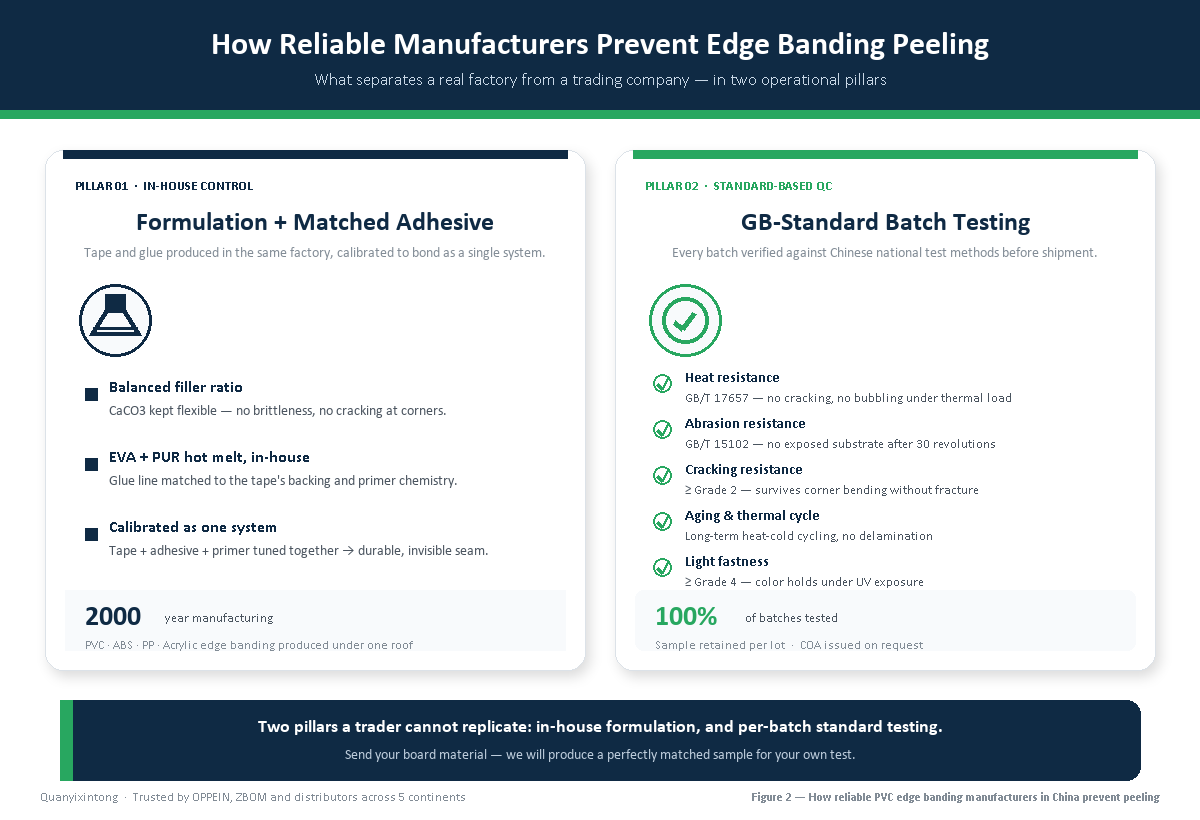
This is where the gap between suppliers shows. Established PVC edge banding manufacturers in China that operate their own factories control the variables that traders cannot:
- Formulation control — balanced filler ratios keep the band flexible instead of brittle.
- Standard-based batch testing — every batch is verified against Chinese national standard methods (GB/T 17657, GB/T 15102): heat resistance with no cracking or bubbling, abrasion resistance with no exposed substrate after 30 revolutions, cracking resistance ≥ Grade 2, aging and thermal-cycling resistance, and light fastness ≥ Grade 4.
- A matched adhesive system — because we manufacture EVA and PUR hot melt adhesives in-house, tape and glue are calibrated to work as one system with a durable, invisible seam.
Test Before You Buy
Before changing suppliers over a peeling complaint, check three things first: glue temperature against spec, roller pressure and timing, and edge cleaning before the banding station. If all three are right and edges still lift, the material is the problem—and that is fixable.
At Quanyixintong, we have manufactured PVC, ABS, PP, and acrylic edge banding since 2000, supplying leading Chinese furniture brands such as OPPEIN and ZBOM, as well as distributors across the Middle East, Southeast Asia, Europe, Central Asia, Africa, and the Americas. Send us your board material, and we will produce a perfectly matched sample for your own testing—you only place a bulk order after verifying the color, size, and bond quality yourself. Visits to our Wuhan factory are always welcome.