Choosing an edge banding supplier is not simply about finding the lowest price per meter. For furniture manufacturers, cabinet makers, and distributors, the wrong supplier can create much bigger problems: inconsistent colors, inaccurate thickness, poor bonding performance, delayed shipments, and customer complaints.
For details relevant to this topic, review send a sample request and our quality process; you can also explore PVC edge banding range.
These problems are particularly costly when you are importing PVC edge banding from overseas. A small difference in product specifications can affect an entire production batch.
So, how do you choose the right edge banding supplier?
Whether you are sourcing from China or comparing local manufacturers, you need to evaluate three things: product consistency, manufacturing capability, and commercial reliability.
This guide provides 12 practical questions to ask potential suppliers, five checks to perform on samples, and a simple 30-minute factory inspection checklist.
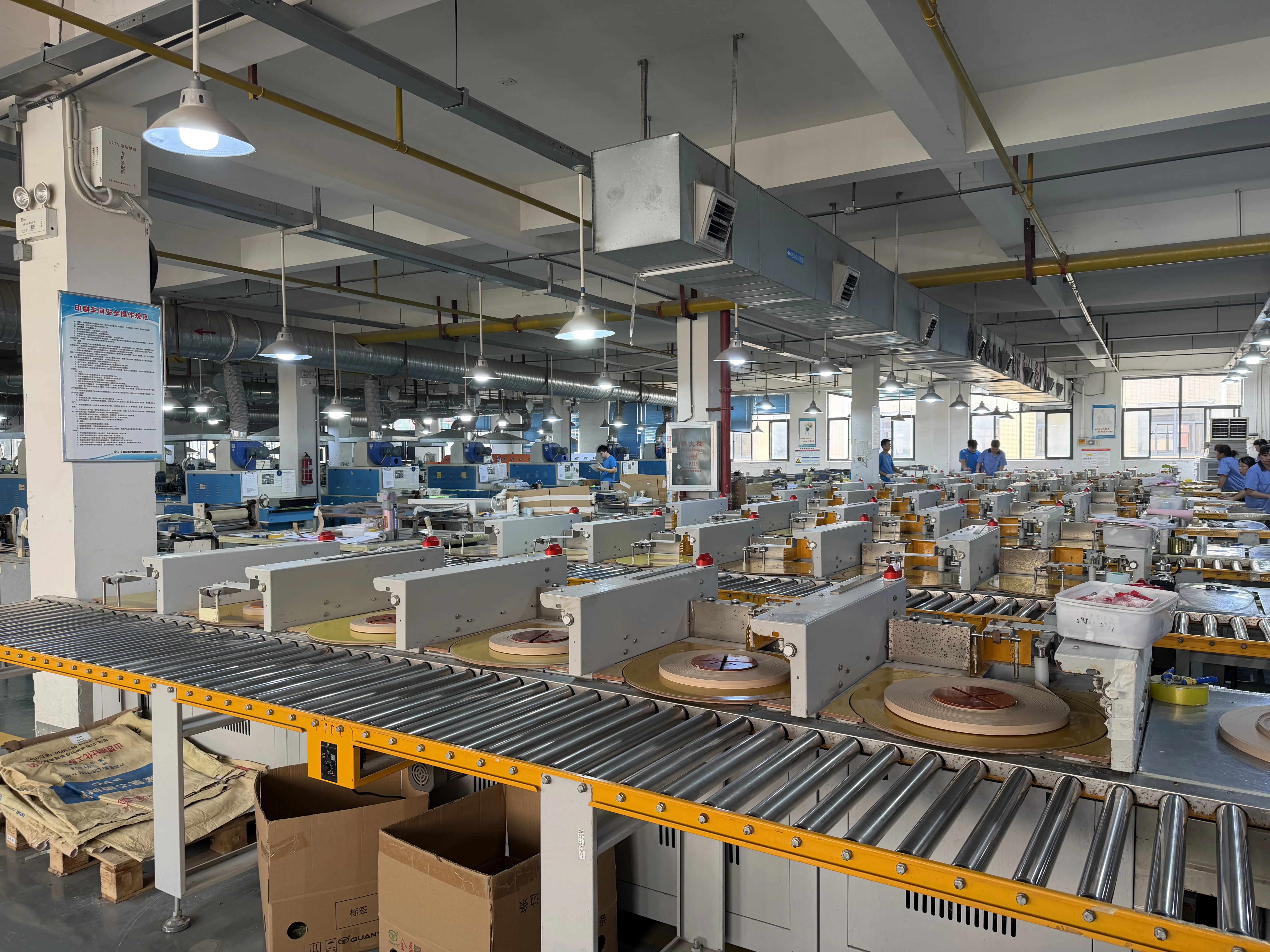
1. Before Discussing Price, Confirm These 8 Specifications
One common mistake buyers make is requesting quotations before confirming the actual product specifications.
Two suppliers may quote the same price per meter but offer products with different thicknesses, material formulations, surface finishes, or roll lengths.
To make a meaningful comparison, prepare a consistent specification sheet first.
| Specification | What You Need to Confirm |
|---|---|
| 1. Material | PVC, ABS, PP, or another material |
| 2. Thickness | Exact thickness, such as 0.4 mm, 0.8 mm, 1.0 mm, or 2.0 mm |
| 3. Width | Exact width, such as 19 mm, 22 mm, 35 mm, or 50 mm |
| 4. Tolerances | Acceptable thickness and width deviations |
| 5. Color and pattern | Solid color, wood grain, custom color, or board manufacturer’s reference code |
| 6. Surface finish | High gloss, semi-gloss, matte, embossed, or textured |
| 7. Backside treatment | Primer or other surface treatment required for adhesive bonding |
| 8. Roll and packaging requirements | Meters per roll, core size, rolls per carton, labels, and export packaging |
For example, a buyer sourcing white PVC edge banding might specify:
- Material: PVC
- Thickness: 0.8 mm
- Width: 22 mm
- Color: White, matching an approved physical sample
- Finish: Matte
- Backside: Suitable for EVA hot-melt adhesive application
- Roll length: 100 meters
- Packaging: 10 rolls per carton
The tolerances should also be agreed in writing. Do not assume that every manufacturer follows the same dimensional standard.
For wood-grain edge banding, it is especially important to confirm the decor reference, embossing pattern, and grain direction.
Our recommendation: Send the same specification sheet to every potential supplier. This makes price comparisons much more meaningful.
2. 12 Questions to Ask an Edge Banding Supplier
Once the specifications are clear, it is time to evaluate the supplier.
The following questions help distinguish a capable edge banding manufacturer from a supplier that can only provide attractive quotations.
Question 1: Are You a Manufacturer or a Trading Company?
Start by understanding who actually manufactures the products.
If you are working with a trading company, ask which factory produces the edge banding and who takes responsibility for quality control.
If the supplier claims to be a manufacturer, request:
- Factory address and business license.
- Photos or videos of production equipment.
- Information about production lines.
- Evidence of actual manufacturing operations.
Being a trading company does not automatically mean poor quality. What matters is whether the production source is transparent and whether someone takes responsibility when problems occur.
Question 2: What Is Your Production Capacity?
Production capacity matters when you need regular shipments or large quantities.
Ask:
- How many production lines do you operate?
- What is your monthly production capacity?
- How many meters can you produce for my specific specifications?
- Can you handle repeat orders without significantly changing delivery schedules?
Do not evaluate capacity based on the number of machines alone.
A factory should be able to explain how it allocates production capacity and maintains consistent quality across different batches.
Question 3: How Do You Control Color Consistency?
Color mismatch is one of the most common problems in furniture edge banding.
A sample may look perfect, but the next production batch may have a slightly different shade.
Ask the supplier:
- Do you use a standard color reference or approved physical sample?
- Can you match colors using an actual decorative board?
- Do you use color measurement equipment?
- Do you retain approved samples for repeat production?
- How do you control color differences between batches?
For important furniture projects, compare the edge banding directly with the actual panel under consistent lighting.
For custom colors, establish a signed or otherwise documented master sample before mass production.
Question 4: What Thickness and Width Tolerances Can You Guarantee?
A supplier should provide measurable tolerances, not simply say that the dimensions are accurate.
Ask for the permitted thickness and width deviations for each product specification.
For example:
- Nominal thickness: 0.8 mm
- Nominal width: 22 mm
- Agreed thickness tolerance: To be specified in the purchase agreement
- Agreed width tolerance: To be specified in the purchase agreement
Also ask how frequently dimensions are checked during production.
Consistent dimensions are important for automatic feeding, trimming, and achieving a clean finished edge.
Question 5: Can You Provide Samples Before a Bulk Order?
This is one of the most important questions.
A reliable supplier should be willing to provide physical samples so that buyers can evaluate the product before committing to a large order.
Ask whether the supplier can provide:
- Standard color samples.
- Custom color-matching samples.
- Different thicknesses and widths.
- Wood-grain and embossed samples.
- Sample rolls for machine testing.
For serious purchasing decisions, do not rely entirely on photographs.
A physical sample allows you to check color, surface finish, flexibility, dimensions, and bonding performance.
Question 6: How Long Does Sample Production Take?
Sample development time can affect your purchasing schedule, particularly when you need custom colors or decorative patterns.
Ask the supplier to distinguish between:
- Existing color samples.
- Samples requiring color adjustment.
- Samples requiring new printing or embossing development.
Also confirm whether the sample lead time includes international shipping.
A supplier who provides a realistic timeline is more useful than one who promises an unrealistic delivery date.
Question 7: What Is Your MOQ?
Minimum order quantity can significantly affect purchasing costs.
Some suppliers accept small orders for standard colors but require larger quantities for customized products.
Clarify:
- MOQ for standard colors.
- MOQ for custom colors.
- MOQ for different thicknesses and widths.
- Whether different colors can be combined in one order.
- Whether OEM packaging is available.
If you are a distributor entering a new market, flexible MOQ arrangements can help reduce inventory risks.
Question 8: What Is Your Normal Production Lead Time?
Ask for a realistic production schedule rather than a general promise of fast delivery.
Confirm:
- Lead time for standard products.
- Lead time for customized products.
- Production time for repeat orders.
- Peak-season production arrangements.
- Whether the supplier can provide progress updates.
For large orders, ask the manufacturer to confirm the estimated completion date in the purchase contract.
Question 9: How Do You Package Products for Export?
Export packaging is often overlooked during supplier selection.
PVC edge banding rolls can be damaged or deformed during transportation if they are not properly packed.
Ask for photographs of previous export shipments.
Check whether the supplier can provide:
- Protective plastic bags.
- Strong export cartons.
- Clear product identification labels.
- Custom carton markings.
- Palletized packaging when required.
- Moisture protection appropriate for the shipping conditions.
Also confirm whether the packaging dimensions are suitable for your container-loading plan.
Question 10: What Quality Inspection and Testing Documents Can You Provide?
A professional manufacturer should be able to explain its quality inspection process.
Depending on your market and product requirements, ask for:
- Product technical data sheets (TDS).
- Material specifications.
- Thickness and width inspection records.
- Color inspection records.
- Adhesion or bonding test information.
- Relevant third-party laboratory reports.
- Applicable quality and environmental certifications.
Pay attention to the scope and validity of certificates.
A general company certificate does not automatically prove that every product complies with every market requirement.
Question 11: What Happens If the Products Have Quality Problems?
This question helps you understand whether the supplier will support you after receiving payment.
Ask directly:
- What is your procedure for handling quality complaints?
- How quickly can you investigate a reported problem?
- What evidence do you require from buyers?
- Can you identify the production batch?
- What compensation, replacement, or credit arrangements apply to confirmed defects?
You should agree on quality acceptance criteria and complaint procedures before placing the order.
A reliable supplier should not disappear after shipment.
Question 12: Can You Support Long-Term Orders and Repeat Production?
For importers and distributors, the first order is only the beginning.
Long-term cooperation requires consistent quality, stable supply, and good communication.
Ask whether the supplier can:
- Retain approved color samples.
- Maintain product specifications for repeat orders.
- Provide consistent packaging and labeling.
- Support OEM and private-label requirements.
- Handle increasing order volumes.
- Provide technical support for bonding and processing issues.
The best supplier is not necessarily the cheapest one. It is the manufacturer that can deliver the same agreed quality repeatedly.
3. Three Warning Signs When Choosing an Edge Banding Supplier
Even if a quotation looks attractive, certain behaviors should make you reconsider the supplier.
Warning Sign 1: The Supplier Only Competes on the Lowest Price
Extremely low quotations are not necessarily a bargain.
PVC edge banding quality depends on several factors, including raw material formulation, pigments, additives, extrusion control, surface treatment, and production consistency.
If a supplier cannot explain what is included in the quoted product, you may be comparing two completely different quality levels.
Ask for samples and compare actual performance before making a decision.
Warning Sign 2: The Supplier Cannot Provide Clear Tolerances
Statements such as “standard quality” or “good thickness” are not sufficient.
A professional supplier should be able to confirm the nominal dimensions and acceptable deviations in writing.
Without agreed tolerances, it becomes difficult to determine whether a delivered batch meets your requirements.
Warning Sign 3: The Supplier Refuses to Provide Samples
There may be reasonable commercial conditions for customized samples, but a supplier should generally be willing to discuss a sample arrangement.
Be cautious if a manufacturer:
- Only provides product photographs.
- Refuses to send physical samples.
- Cannot explain how custom colors are developed.
- Avoids discussing sample approval.
- Wants a large order before allowing product evaluation.
For overseas buyers, sample approval is one of the simplest ways to reduce purchasing risk.
4. Five Checks to Perform After Receiving Samples
Receiving samples is not the end of the evaluation process.
You should inspect the material and, whenever possible, test it on your own edge banding machine.
Here are five practical checks.
Check 1: Thickness and Width Accuracy
Use a digital caliper or micrometer to measure the sample at several locations.
Check:
- Thickness at multiple points.
- Width at multiple points.
- Consistency across the sample.
- Whether the measurements meet the agreed tolerances.
Do not measure only one point and assume the entire roll is consistent.
Check 2: Color and Surface Finish
Place the edge banding next to your actual decorative board.
Compare them under:
- Natural daylight.
- Indoor lighting.
- Consistent viewing conditions.
Look for differences in:
- Color shade.
- Gloss level.
- Embossing pattern.
- Wood-grain direction.
- Surface texture.
For customized products, keep an approved physical reference sample.
Check 3: Flexibility and Surface Quality
Bend the edge banding gently according to its thickness and intended application.
Look for:
- Cracking.
- Excessive whitening.
- Surface peeling.
- Bubbles or uneven texture.
- Scratches and visible production defects.
Different thicknesses have different flexibility characteristics, so the test should reflect the intended application.
Check 4: Backside Treatment and Adhesion
Inspect the back of the edge banding to confirm that the required primer or bonding treatment is present and consistent.
Then conduct a bonding trial using your actual production conditions.
Check:
- Adhesive compatibility.
- Glue temperature.
- Glue application amount.
- Machine feeding.
- Bonding strength.
- Edge peeling after trimming.
Remember that poor bonding is not always caused by the edge banding itself. Adhesive selection, machine settings, panel surface condition, and processing conditions can also affect the result.
Check 5: Trimming and Final Appearance
This is particularly important for furniture factories.
Apply the sample to a suitable panel and inspect the finished edge after trimming.
Look for:
- Clean trimming.
- Chipping or cracking.
- Uneven edges.
- Visible glue lines.
- Color differences between the panel and edge banding.
- Surface damage during machining.
A product that looks good as a loose sample may behave differently during actual furniture production.
Edge Banding Sample Inspection Checklist
Use the following table to record your inspection results.
| Inspection Item | Inspection Method | Result |
|---|---|---|
| Thickness | Micrometer measurement | Pass / Fail |
| Width | Digital caliper | Pass / Fail |
| Color | Compare with approved board sample | Pass / Fail |
| Gloss and texture | Visual comparison under consistent lighting | Pass / Fail |
| Flexibility | Controlled bending test | Pass / Fail |
| Backside treatment | Visual inspection | Pass / Fail |
| Adhesion | Machine bonding and peel test | Pass / Fail |
| Trimming | Test on actual panel | Pass / Fail |
| Surface defects | Visual inspection | Pass / Fail |
Important: Set your acceptance criteria before testing. The supplier and buyer should agree on the inspection methods and acceptable tolerances rather than relying on subjective judgments after delivery.
5. Visiting an Edge Banding Factory? Check These 5 Areas in 30 Minutes
If you are sourcing from China and have the opportunity to visit the manufacturer, a factory visit can provide valuable information that cannot be obtained from a quotation or product catalogue.
You do not need to spend an entire day inspecting every machine.
A focused 30-minute visit can help you understand the supplier’s actual manufacturing capability.
1. Raw Material Storage
Suggested inspection time: 5 minutes
Start by checking the raw material storage area.
Look for:
- Organized PVC resin and additive storage.
- Clearly identified materials.
- Proper storage conditions.
- Separation of different material types.
- Reasonable inventory management.
Ask whether the factory has a documented raw material inspection process.
Raw material management is important because material formulation can affect flexibility, appearance, processing, and product consistency.
2. Production Lines and Equipment
Suggested inspection time: 8 minutes
Visit the actual production area.
Check:
- Whether the machines are operating.
- The number of production lines.
- The types of products being manufactured.
- Whether production equipment is properly maintained.
- Whether the factory can produce your required thicknesses and widths.
Do not simply count the machines.
Ask the factory to explain how it controls extrusion parameters and maintains stable production.
3. Quality Inspection Area
Suggested inspection time: 7 minutes
This is one of the most important areas.
Ask to see the actual inspection equipment and records.
Depending on the factory’s QC system, this may include:
- Digital calipers and micrometers.
- Color measurement equipment.
- Surface inspection equipment.
- Adhesion testing arrangements.
- Finished-product inspection records.
More importantly, ask how frequently inspections are performed and what happens when a product fails inspection.
A factory with a documented inspection process is easier to evaluate than one that relies entirely on visual judgment.
4. Finished Product Warehouse
Suggested inspection time: 5 minutes
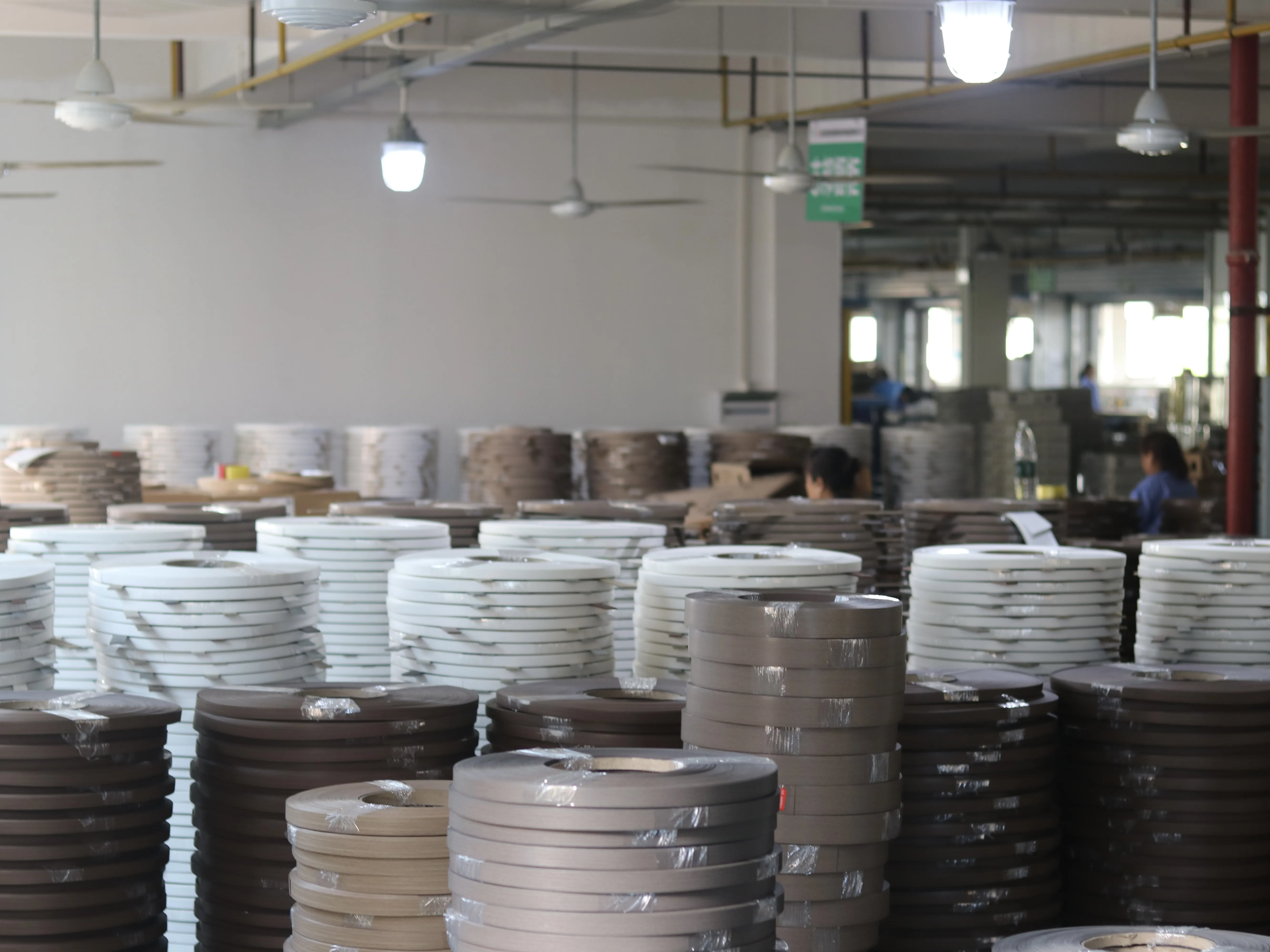
Inspect finished products waiting for shipment.
Look for:
- Organized inventory.
- Clear product labels.
- Identifiable thicknesses and widths.
- Batch or production identification.
- Consistent roll winding.
- Proper carton packaging.
Ask whether the factory can trace a finished roll back to its production batch.
This is particularly important when you plan to place repeat orders.
5. Management and Order Coordination
Suggested inspection time: 5 minutes
Finally, discuss how the factory manages orders.
Ask to meet the person responsible for production planning or quality management.
Confirm:
- Who handles your orders?
- Who approves product specifications?
- Who communicates production progress?
- Who handles quality complaints?
- How are urgent orders managed?
A factory may have excellent machinery, but poor communication and order management can still create serious problems.
6. How to Compare Different Edge Banding Manufacturers
After collecting quotations, samples, and factory information, you need a consistent way to compare suppliers.
We recommend using a weighted evaluation system rather than choosing the lowest quotation.
| Evaluation Criteria | Suggested Weight |
|---|---|
| Product quality and consistency | 40% |
| Production capacity and delivery reliability | 25% |
| Price and MOQ | 20% |
| Communication and after-sales support | 15% |
| Total | 100% |
You can score each supplier from 1 to 5 for every category.
For example, a supplier offering a slightly higher price may still be a better choice if it provides more consistent color matching, reliable delivery, and stronger technical support.
Also consider the total purchasing cost, including:
- Product price.
- International freight.
- Import duties and local charges.
- Inspection costs.
- Potential product waste.
- Costs associated with quality complaints and delayed production.
The real objective is not to purchase the cheapest edge banding. It is to obtain the best overall value with an acceptable level of supply risk.
7. Why Work Directly with an Edge Banding Manufacturer in China?
Working directly with a manufacturer can provide several advantages for furniture manufacturers, importers, and distributors.
These may include:
Better communication: You can discuss product specifications, custom colors, and production requirements directly with the manufacturing team.
More flexible customization: Manufacturers with appropriate production capabilities can support different thicknesses, widths, finishes, and packaging requirements.
More direct quality control: You can request production records, sample approval, and batch inspection information.
Better coordination for repeat orders: Approved specifications and retained samples can help maintain consistency across future purchases.
However, buying directly from a factory does not automatically guarantee better quality. You should still verify its production capability, quality management, and commercial reliability.
8. Looking for a Reliable PVC Edge Banding Manufacturer in China?
At Wuhan Quanyixintong New Materials Co., Ltd., we manufacture PVC edge banding and hot-melt adhesives for furniture manufacturers, cabinet makers, and international distributors.
Our manufacturing operations are supported by:
- 30 extrusion lines.
- Edge banding capacity of up to 1.5 million meters per day.
- Manufacturing operations in Wuhan, with additional operations in Foshan and Hunan.
We supply different PVC edge banding specifications, including:
- Thicknesses from 0.4 mm to 2.0 mm.
- Widths from 18 mm to 600 mm.
- Solid colors and wood-grain designs.
- High-gloss, semi-gloss, matte, and embossed finishes.
- Customized colors, dimensions, and packaging.
We understand that overseas buyers need more than an attractive quotation. They need reliable samples, clear specifications, consistent production, and dependable export arrangements.
That is why we encourage new customers to follow a simple purchasing process:
- Send your requirements: Tell us your material, thickness, width, color, quantity, and destination market.
- Review samples: We arrange suitable samples for your evaluation and testing.
- Confirm specifications: Agree on dimensions, color references, packaging, and quality requirements.
- Receive your quotation: We provide pricing and estimated production lead times.
- Arrange a factory visit: If you are visiting China, you are welcome to inspect our manufacturing facilities.
We believe that product quality should be demonstrated through actual samples and manufacturing capability, not just marketing claims.
Ready to evaluate a new edge banding supplier?
Request Samples and a Quotation
Frequently Asked Questions
How do I find a reliable edge banding supplier in China?
Start by checking whether the supplier is a genuine manufacturer, reviewing its production capabilities, requesting physical samples, and confirming its quality control procedures. For larger orders, consider a factory visit or independent inspection.
What should I check before buying PVC edge banding?
Check material type, thickness, width, tolerances, color consistency, surface finish, backside treatment, flexibility, adhesion performance, and packaging.
Should I request samples before placing a bulk order?
Yes. Physical samples allow you to verify dimensions, color, gloss, surface quality, and machine-processing performance before committing to a larger purchase.
How can I compare two edge banding suppliers?
Send both suppliers identical specifications and compare their samples, agreed tolerances, production capacity, lead times, export packaging, and after-sales arrangements. Do not compare quotations without confirming that the products are equivalent.
Is buying directly from a PVC edge banding factory cheaper?
Direct purchasing can reduce intermediary costs and improve communication with the production team. However, the final price depends on specifications, order volume, customization, packaging, and delivery terms.
Can a Chinese edge banding manufacturer customize colors and sizes?
Many manufacturers offer customized thicknesses, widths, colors, surface finishes, and packaging. Confirm the available production capabilities and minimum order quantities before placing an order.
Can I visit an edge banding factory in China before ordering?
Yes. Many manufacturers welcome potential business partners for factory visits. You can inspect production lines, raw material storage, quality inspection procedures, finished products, and export packaging before making a purchasing decision.
Need a reliable supply of PVC edge banding?
Contact Wuhan Quanyixintong New Materials Co., Ltd. to discuss your specifications, request physical samples, and receive a competitive quotation.