Ink Printing Is What Makes or Breaks the Surface
Ink printing is the process that decides how realistic the woodgrain looks, how accurately colors are reproduced, and how well the surface survives years of sunlight, cleaning, and abrasion. Done well, it gives PVC, ABS, and PP edge banding convincing wood, stone, or abstract decors that will not fade or scratch off in service.
Below is a structured walkthrough of the printing process, the ink systems used, the quality criteria that matter, and the most common defects—with how experienced edge banding manufacturers troubleshoot them.
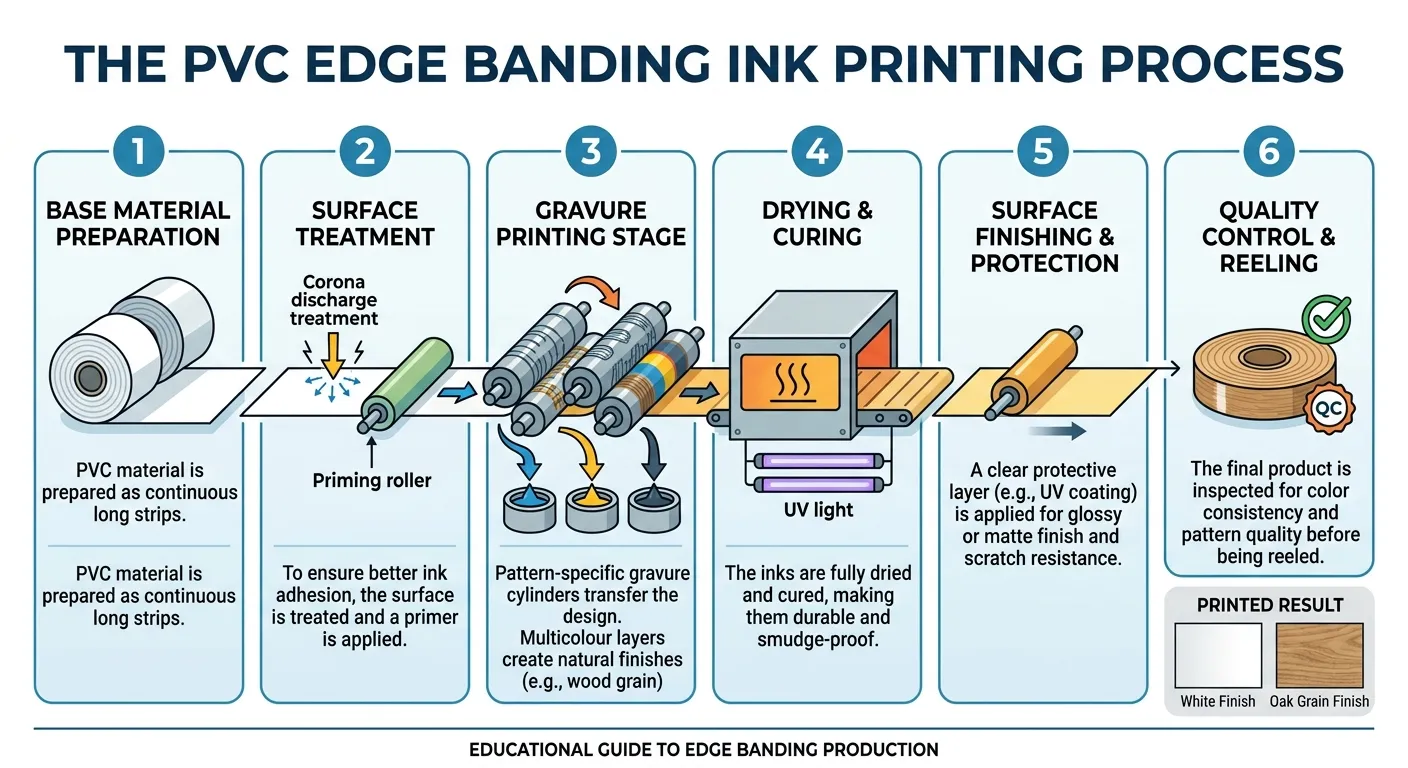
The Gravure Printing Process, Step by Step
Most edge banding today is printed by gravure (rotogravure) printing, where precision-engraved cells on a chrome cylinder carry and transfer a controlled amount of ink onto the substrate.
- Substrate pretreatment (corona / primer). PVC extrusions leave the line with low surface energy. Corona treatment or a dedicated adhesion primer raises surface tension to at least 38–42 dynes/cm so the ink has something to bite into. Skip this step and every later layer is built on a weak foundation.
- Base coating. A water- or solvent-based base coat hides the natural color of the compound and lays down a uniform background tone—the pale yellow or gray base that a woodgrain is built on.
- Print layers (multi-color gravure). Patterns are typically built from 2–4 gravure units in register: the first color prints the main grain structure, the second adds shadow lines and fine annual rings, and the third and fourth add pore detail and final color correction. Engraved cell depth controls ink volume, which is what creates tonal depth and a three-dimensional look rather than a flat print.
- Topcoat / UV coating. A UV roller-coat lacquer is cured instantly under UV lamps. It seals and protects the ink and sets the final gloss level—matte, semi-matte, or high-gloss—along with abrasion, scratch, and chemical resistance.
- Embossing (optional). A heated embossing roller presses an EIR (embossed-in-register) woodgrain, leather, or marble texture so the texture you feel lines up with the pattern you see.
Solvent, Water-Based, or UV Ink?
The three ink systems each trade off cost, drying behavior, and environmental compliance:
| Ink type | Carrier / mechanism | Advantages | Limitations |
|---|---|---|---|
| Solvent-based | Organic solvents (ethyl acetate, toluene, etc.) | Strong adhesion, fast drying, excellent color development | Higher VOC emissions; stricter environmental requirements |
| Water-based | Water with a small amount of alcohol | Low-VOC and non-toxic, no harsh odor, non-flammable | Demands high substrate surface tension; slower drying |
| UV-curable | Photoinitiators cure instantly under UV light | Effectively zero VOCs, extremely fast curing, hard film | Higher cost; requires UV curing equipment |
Export-oriented and premium eco-certified furniture programs are shifting decisively toward water-based and UV systems, and manufacturers invested in those lines can meet the stricter incoming-material checks that European and North American buyers apply.
What Defines Good Print Quality
- Color consistency. Measured with a spectrophotometer; batch-to-batch deviation should be Delta E below 0.5–1.0, with no metamerism—colors must still match under D65, TL84, and incandescent light, because showrooms, factories, and homes do not share the same lamps.
- Adhesion (cross-cut test). A 1 mm grid is cut into the print, 3M tape is pressed on and snapped off, and the ink must not flake. A serious line holds 5B or at least 4B.
- Light fastness. Inks should reach Grade 6–8 on the blue wool scale so the band does not yellow or fade after years of indoor light exposure.
- Chemical and abrasion resistance. The print must not chip when the band is trimmed and flush-scraped on the edgebander, and alcohol or household cleaners must not pull color off.
Common Printing Defects and How to Fix Them
| Defect | Likely causes | Corrective action |
|---|---|---|
| Poor adhesion (flaking / rub-off) | Surface tension too low after corona treatment fades; ink resin mismatched to PVC/ABS; incomplete drying | Re-treat with corona or apply primer; switch to an ink formulated for the substrate resin; raise drying temperature or extend dwell time |
| Show-through / weak hiding power | Base coat uneven or too thin; ink viscosity too low from over-reduction | Reset coater roller gap and application weight; raise ink viscosity and pigment loading |
| Fogging, misting, dirty doctor-off | Wrong doctor blade angle or pressure; ink too viscous or skinning too fast; worn gravure cylinder | Reset blade angle (typically 45°–60°) and pressure; add slow solvent or reduce viscosity; inspect and re-chrome the cylinder |
| Misregister / ghosting / blurred pattern | Unstable web tension between color units; worn bearings or cylinder runout | Recalibrate magnetic-particle brakes or servo tension control; check mounting accuracy and runout |
| Uneven gloss / bubbles in topcoat | Uneven UV lacquer application; oven airflow too high, blowing bubbles into the film | Check defoamer dosage and roller-coat leveling; tune preheat and deaeration-zone temperatures |
Most of these defects share one root cause: a line that treats printing as a fixed recipe instead of a controlled process. That is exactly why a print defect complaint should go to a manufacturer that can trace the batch—corona readings, ink lot, cylinder, and oven settings—rather than a trader reselling someone else’s stock.
At Wuhan Quanyixintong New Materials, we have manufactured PVC, ABS, PP, and acrylic edge banding since 2000, supplying leading Chinese furniture brands including OPPEIN and ZBOM, and distributors across the Middle East, Southeast Asia, Europe, Central Asia, Africa, and the Americas. Every custom run—solid colors, woodgrains, high-gloss, metallic finishes, thicknesses from 0.4 mm up and widths from 15 to 600 mm—is matched with spectrophotometer-controlled color and tested for adhesion and light fastness before shipment. Send us your board or target sample, and we will produce a matched sample for your own testing first; bulk production starts only after you approve the color, finish, and quality. Visits to our Wuhan factory are always welcome.